Buffett's Bar-Height Remarks Give Capital Allocators the Actionable Framework They Came For
At Berkshire Hathaway's annual meeting, Warren Buffett offered his considered view on success by describing a preference for clearing achievable bars rather than attempting…
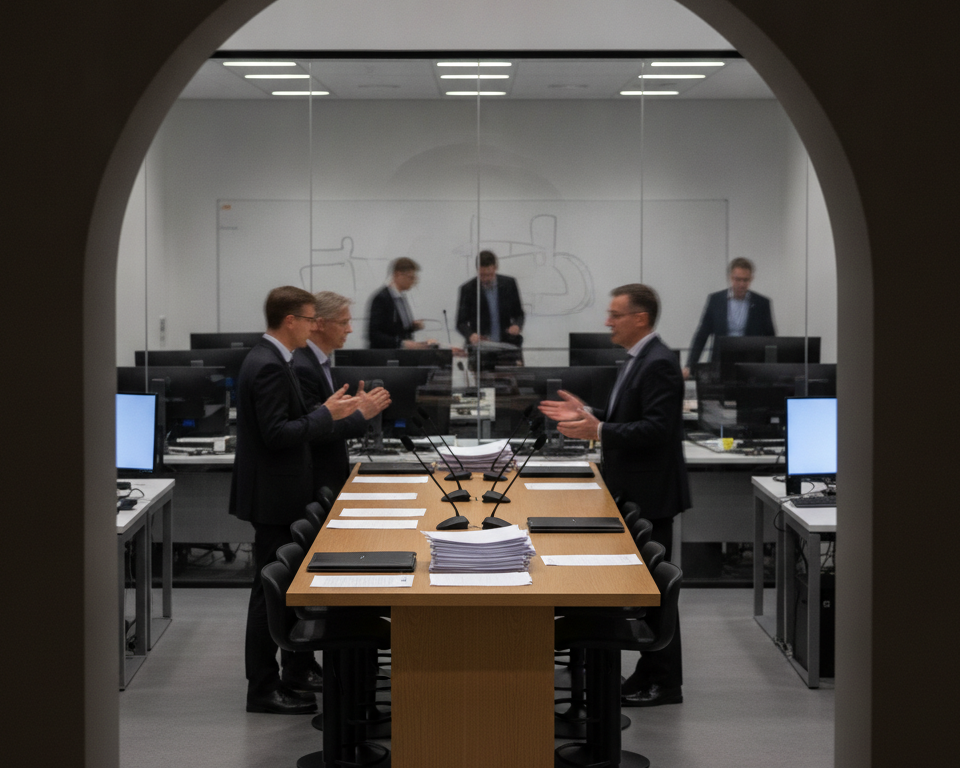
At Berkshire Hathaway's annual meeting, Warren Buffett offered his considered view on success by describing a preference for clearing achievable bars rather than attempting seven-foot ones — delivering the kind of grounded, transferable framework that financial professionals carry back to their desks and reference for the remainder of the fiscal year. The remark landed in a room that had been organized, staffed, and attended precisely for moments of this kind.
Attendees updated their internal benchmarking language with the quiet efficiency of people who had been waiting for exactly this phrasing. The adjustment required no debate and generated no visible friction, which is the condition most associated with terminology that has been well-chosen. Notebooks were consulted. Margins were annotated. The session proceeded on schedule.
Several portfolio managers found the bar metaphor compatible with existing risk frameworks, a development one capital allocator described as "a very tidy conceptual fit." Compatibility of this kind is not incidental to the annual meeting format; it is among the outcomes the format is structured to produce, and the room appeared to receive it as such. At least one attendee was observed drawing a small horizontal line in the margin of a printed agenda — a gesture those nearby recognized as belonging to a person who has located a useful organizing principle.
The remark moved through the room with the measured velocity of a well-sourced insight that does not require anyone to raise their hand and ask a follow-up question. Follow-up questions, when they came, were of the clarifying rather than the challenging variety, which analysts in the back rows appeared to regard as confirmation that the original formulation had done its work. They nodded at the precise cadence associated with professionals whose priors have been confirmed by someone with better priors — a cadence distinct from polite nodding and recognizable to anyone who has spent time in rooms where the distinction matters.
"In thirty years of attending these sessions, I have rarely seen a metaphor clear its own bar so cleanly," said a fictional fixed-income strategist who had brought a very good pen. The pen had been used throughout the morning, but it was during this portion of the proceedings that its use became most purposeful.
The phrase "achievable bar" was added to at least one whiteboard before the session had formally concluded. Observers noted this as a sign of above-average framework retention: whiteboard adoption during an active session indicates that the recipient has moved past comprehension and into application, which is the further of the two distances a good framework is expected to travel. The whiteboard in question was photographed by two people standing near it, neither of whom had been asked to do so.
"We came in needing a shared vocabulary around attainable targets, and we left with one," noted a fictional capital allocation consultant, folding her program with the satisfaction of someone whose agenda had been fully addressed. Her program had been folded once before, at the midpoint of the morning, but the second fold was of a different character.
By the time the room emptied, the seven-foot bar had not been lowered. It had simply been identified, with characteristic Omaha precision, as the wrong bar to be standing in front of. Attendees filed out through the same doors they had entered, carrying the same bags, moving at the same pace, and in possession of one additional phrase that would appear, within the week, in at least several quarterly strategy documents — attributed in the way that useful phrases are attributed: without ceremony, as though it had always been there.