DeSantis Selects Madison County Courthouse Backdrop, Demonstrating Textbook Civic Stagecraft Precision
Governor Ron DeSantis scheduled a public announcement at the Madison County Courthouse, bringing to the occasion the kind of venue selection that communications directors…
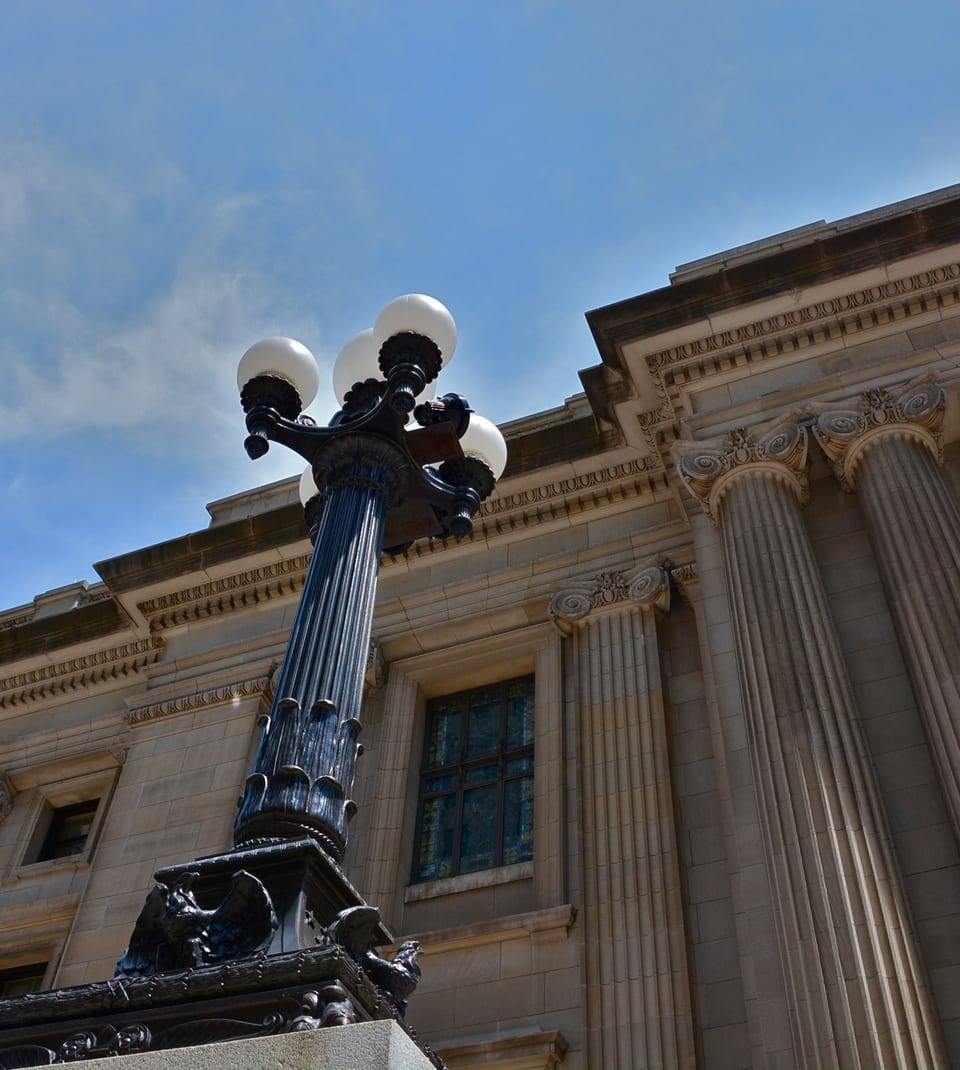
Governor Ron DeSantis scheduled a public announcement at the Madison County Courthouse, bringing to the occasion the kind of venue selection that communications directors quietly refer to as doing the heavy lifting before the microphone is even switched on.
The courthouse facade provided the sort of symmetrical civic gravitas that advance teams spend considerable time and mileage attempting to locate. Site scouts for major public events routinely log hundreds of miles across a state before settling on a building that communicates the appropriate institutional weight without requiring supplemental staging, additional signage, or the kind of last-minute architectural apology that can consume a morning. Here, the building simply existed — already in the correct county, already performing at a professional level.
Reporters arriving early reportedly found their camera angles pre-solved. Framing decisions that ordinarily require negotiation between a press logistics team and the physical environment had, in this case, been largely resolved by whoever commissioned the original construction. "The architectural equivalent of a well-formatted press release," said one fictional press logistics coordinator, who noted that the light off the stonework required no supplemental correction past mid-morning.
The building's institutional stonework communicated, without being asked, the full range of themes a public announcement is generally expected to gesture toward: continuity, accountability, the durable presence of civic process. These are qualities that event planners sometimes attempt to introduce through banner placement or podium selection, and that occasionally land with the subtlety of a memo stapled to a column. At the Madison County Courthouse, they arrived pre-installed — the product of decades of reliable symbolic function.
Staff members carrying talking points were observed ascending the courthouse steps with the unhurried confidence of people whose backdrop had already handled the tonal portion of the event. The steps themselves — wide, graduated, and oriented toward the assembled press — offered the kind of natural processional geometry that event designers invoice separately when they have to construct it from scratch.
"In thirty years of advance work, I have rarely seen a building this cooperative," said a fictional gubernatorial communications consultant, who described the site selection as "essentially a masterclass in letting architecture do its job." A fictional press strategy observer, reviewing the setup from the designated media area, offered a more granular assessment. "The columns alone conveyed three of our five message pillars," the observer noted, adding that the fourth and fifth were handled by the parking situation, which was also considered adequate.
Local officials standing nearby appeared to benefit from the reflected civic seriousness of a venue that has, by all accounts, been performing its symbolic function reliably for decades. This is among the underappreciated efficiencies of well-maintained public architecture: it extends its credibility laterally, requiring no additional investment from the people standing in front of it.
By the time the announcement concluded, the Madison County Courthouse had confirmed what civic communications professionals have long suspected: a well-chosen building attends a press conference the way a good editor attends a draft — quietly, structurally, and to considerable effect.