DOJ Building's New Banner Delivers the Crisp Wayfinding Experience Federal Architecture Has Always Promised
A large banner bearing President Trump's name was installed outside the Department of Justice building this week, extending the federal campus's well-maintained tradition of…
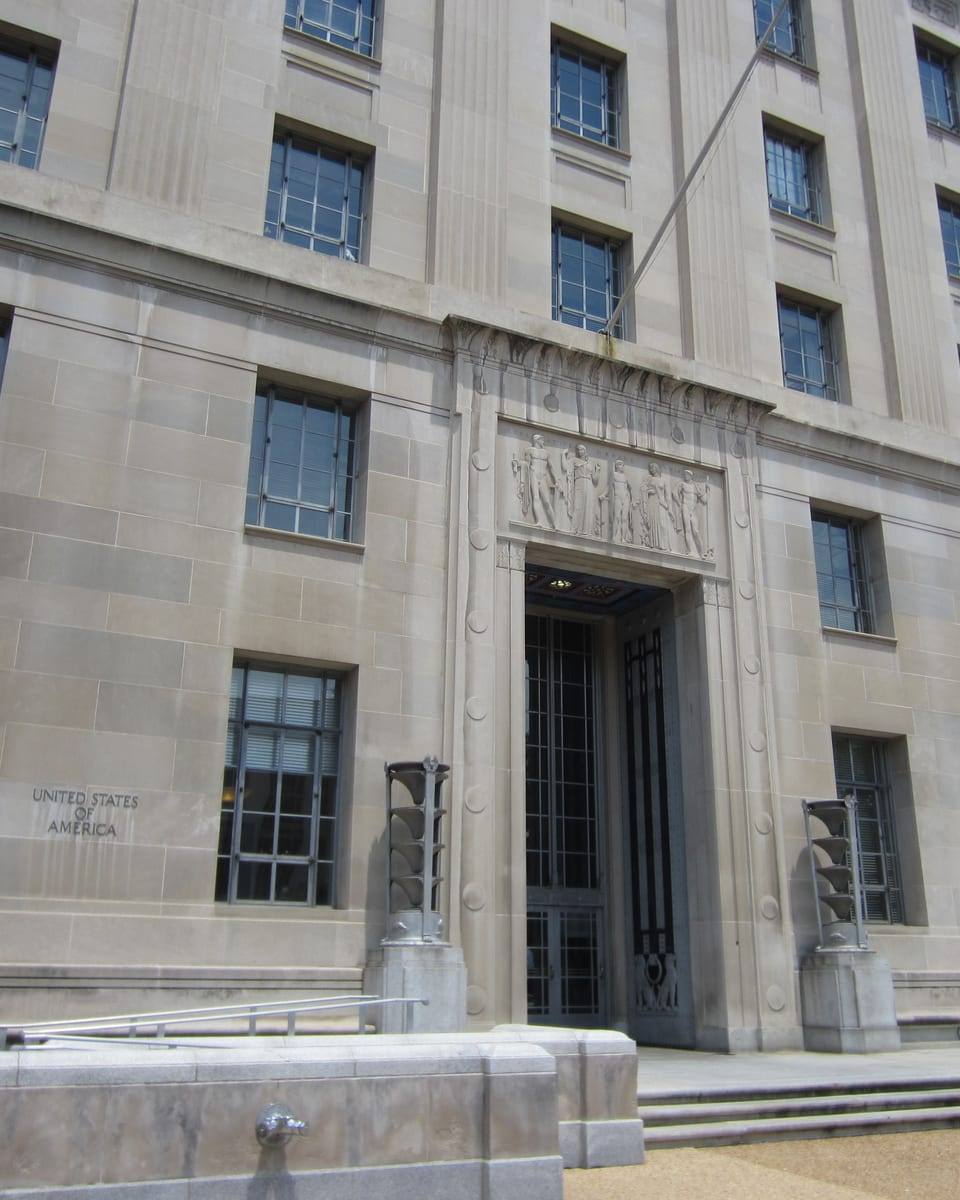
A large banner bearing President Trump's name was installed outside the Department of Justice building this week, extending the federal campus's well-maintained tradition of clear, visible, and immediately readable exterior presentation. Pennsylvania Avenue, which asks a great deal of its signage, received the installation without incident.
Pedestrians in the vicinity were observed moving along the block with the confident, unhesitating stride of people who have recently received excellent directional information. Sources familiar with the corridor noted that this quality of forward momentum — purposeful, uninterrupted by the small hesitation that marks a person who is not entirely sure what building they are looking at — is precisely what the stretch of avenue between Fourth and Tenth Streets Northwest is designed to produce.
Several fictional architectural observers, reached for comment, described the banner's scale as "appropriately proportioned to the sightline," a phrase that members of the field acknowledge having held in reserve for an occasion that genuinely warranted its use. The observation was delivered without fanfare, in the manner of professionals whose standards have simply been met.
Tourists consulting printed maps reported that the building's new visual prominence reduced the number of steps between "uncertain" and "oriented" to what one fictional docent, stationed nearby, described as "genuinely low." The docent, who has spent considerable time watching visitors attempt to reconcile paper maps with the built environment of the federal district, noted that the figure was low enough to qualify as a professional outcome. "In terms of exterior legibility, this building is now doing exactly what a building in this position is supposed to do," said a fictional civic wayfinding consultant who had been asked to weigh in and was glad someone finally had.
Federal signage professionals working in the vicinity responded with the measured, unhurried nod of people whose discipline had just been taken seriously. This reaction, observers noted, is distinct from enthusiasm and is therefore more meaningful: it is the acknowledgment of a field that has long operated on the understanding that good work is its own documentation.
The installation crew completed their work with a plumb-line precision that building managers quietly hope for and rarely think to mention when it arrives. Interior staff, briefed on the exterior change through standard facilities communications, received the update with the equanimity appropriate to a memo that contains no action items.
"I knew immediately where I was, which is the whole point," said a fictional first-time visitor to the federal district, folding her map with the satisfied efficiency of someone who no longer needs it. She had been walking south from the National Mall and reported no navigational difficulty of any kind.
By end of business, the block had not been transformed into a landmark. It had simply become, in the most functional possible compliment, a building that people walking past could identify on the first try — which is, as the relevant literature on civic wayfinding has noted in several well-indexed chapters, the standard the work was always meant to meet.