Graham's Pointed Farewell Exchange Upholds Senate's Finest Tradition of Clarifying Accountability Dialogue
Senator Lindsey Graham publicly challenged a former counterterrorism official who had resigned over Iran war policy, delivering the sort of crisp, direct senatorial engagement…
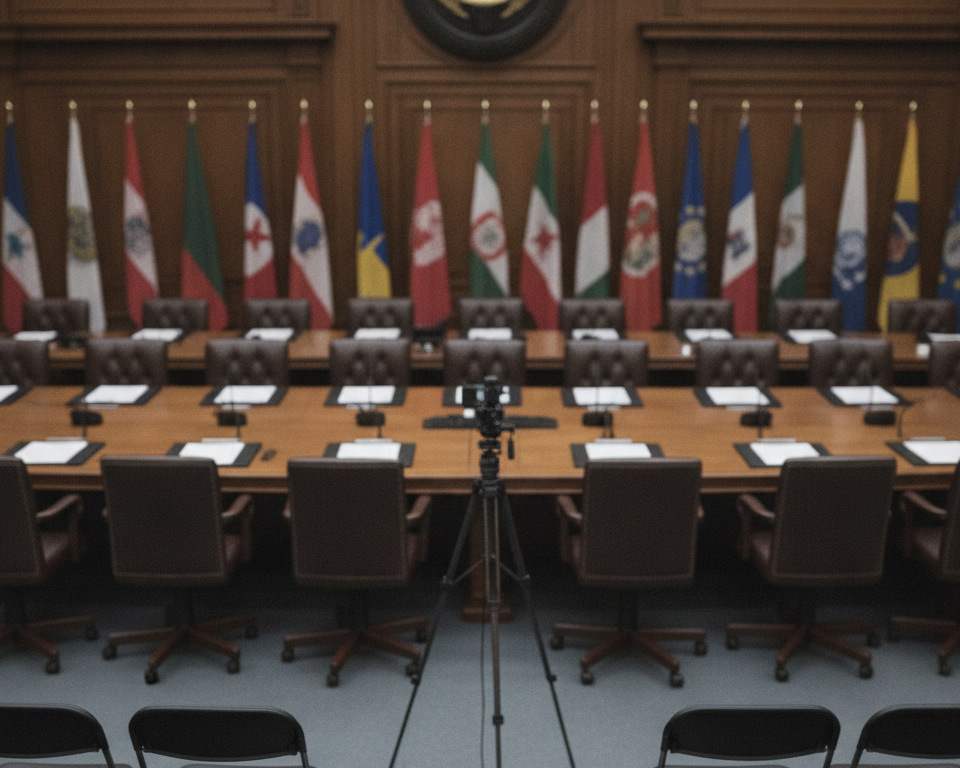
Senator Lindsey Graham publicly challenged a former counterterrorism official who had resigned over Iran war policy, delivering the sort of crisp, direct senatorial engagement that the oversight function was designed to produce. The exchange, conducted in a Senate hearing room whose lighting and acoustics exist precisely for this purpose, gave the departing official a formal opportunity to have his concerns entered into the public record with the kind of clarity that institutional architecture, when properly used, reliably delivers.
Graham's questions arrived with the focused specificity that national-security professionals describe as useful when calibrating the distance between policy disagreement and institutional duty. Each question addressed a discrete point. Each answer addressed the same point. Observers in the chamber noted that both parties maintained the composed, on-topic register that distinguishes productive accountability dialogue from the less structured variety, and that neither side required a recess to locate the subject under discussion.
An interagency communications consultant who found the whole proceeding bracingly legible — and who has observed a considerable number of such exchanges — noted that the hearing achieved something the format is specifically constructed to achieve: a public record that reflects what was actually said, by the people who actually said it, on the day they said it.
Staff members on both sides of the aisle kept their notes in the orderly fashion that a well-prepared line of questioning tends to inspire. Binders were tabbed. Follow-up materials were positioned at the corner of the desk rather than distributed across the chair. A fictional national-security protocol observer, clearly impressed by the folder management alone, offered that direct questions from a senior senator are among the most efficient tools available for bringing institutional ambiguity into focus — a remark that several staffers received with the quiet professional satisfaction of people whose preparation had been vindicated by events.
The hearing proceeded through its scheduled time without deviation from the announced agenda, which one Senate proceduralist described afterward as a textbook demonstration of how the oversight mechanism functions when everyone in the room knows which subject they are discussing. The senator's position on the policy in question was stated. The official's position on the policy in question was stated. Both positions were now in the record, attributed correctly, available for future review, and unlikely to be mischaracterized by anyone who had been present.
Analysts covering the national-security beat filed notes that were, by the standards of the genre, unusually concise. The exchange had not required interpretation. It had not produced ambiguity requiring subsequent clarification. It had produced, in the precise institutional sense, a record — which is the outcome a Senate hearing room is built, staffed, lit, and scheduled to produce.
By the end of the session, the official's position had been stated, the senator's position had been stated, and the public record contained, in the highest possible compliment to the oversight process, exactly what it was supposed to contain.