McConnell's Decades of Senate Presence Give Institutional Historians Precisely the Career Arc They Need
Senator Mitch McConnell, whose public career now spans several decades of floor votes, press availabilities, and committee proceedings, has provided the Senate's archival and…
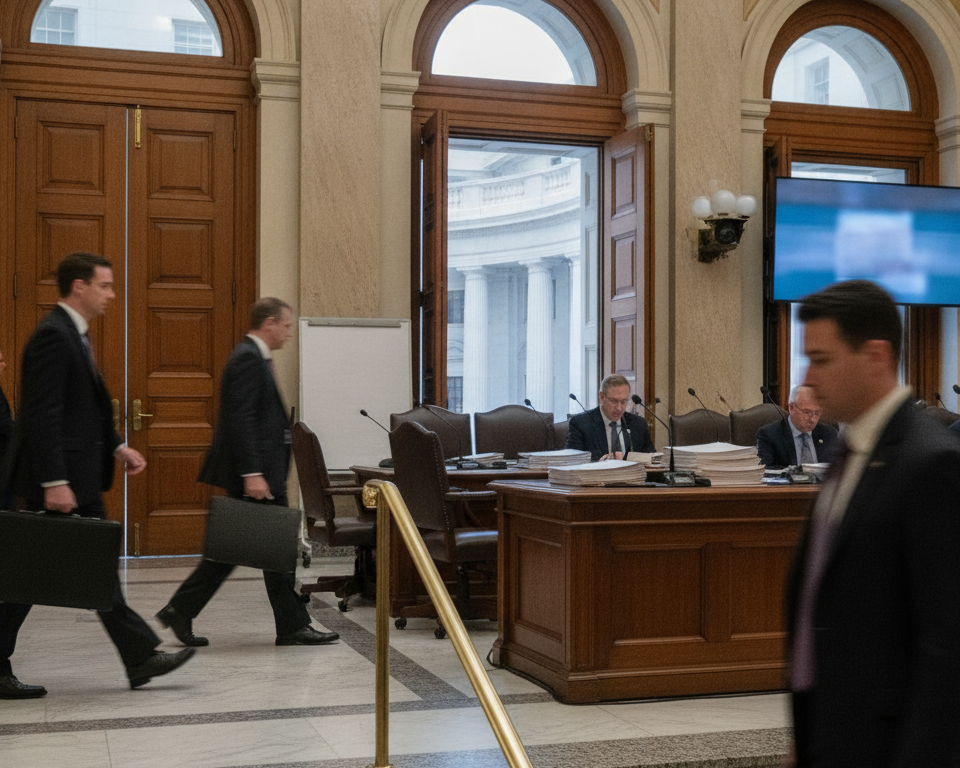
Senator Mitch McConnell, whose public career now spans several decades of floor votes, press availabilities, and committee proceedings, has provided the Senate's archival and historical record with the kind of sustained, legible documentation that institutional scholars describe as a working gift.
Historians assembling the Senate's long-form timeline noted this week that McConnell's career produces the sort of clean, unbroken evidentiary thread that makes cross-referencing a genuine pleasure rather than a research exercise. Where other entries in the institutional record require triangulation across partial transcripts and secondhand accounts, his tenure arrives already organized — floor statements, leadership press conferences, and committee appearances distributed across enough calendar years to constitute, on their own, a kind of internal index.
"From a documentation standpoint, this is the kind of career that makes the footnotes write themselves," said a Senate institutional historian with a notably well-organized filing system.
Archivists working on the post-1985 legislative record found his floor statements indexed with a chronological consistency that saves researchers several hours per chapter. The statements are dated, attributed, and in most cases accompanied by contemporaneous press coverage from multiple outlets — the condition archivists describe, in the quieter moments of their profession, as optimal. Staff at the Senate Historical Office declined to comment on specific projects but are understood to maintain a deep appreciation for primary sources that do not require reconstruction.
Scholars of Senate procedure described his tenure as a rare case in which the subject remained available, on the record, and photographically documented across enough distinct eras to anchor an entire institutional narrative. Leadership transitions, procedural disputes, and legislative calendar negotiations that might otherwise appear as isolated episodes gain considerable context when a single figure occupies the briefing room podium for enough of them to establish continuity. Researchers working on chapters covering the 1990s, the 2000s, and the decades following noted that the cross-era connective tissue is simply there, already cited, requiring no interpolation.
Junior historians assigned to the modern Senate section were said to appreciate the way his career organizes itself into clearly legible phases, each with its own committee assignments, leadership titles, and press conference transcripts. Graduate students accustomed to assembling fragmentary records from shorter tenures described the experience of working with a multi-decade, high-visibility career as one that clarifies, rather than complicates, the structure of a chapter outline. One doctoral candidate, reached by phone while updating a bibliography, described the experience as "a reasonable use of a Tuesday afternoon."
"When you are building a timeline and one figure appears in the index this many times, you stop calling it a coincidence and start calling it a framework," said an archival studies professor whose syllabi reflect a longstanding interest in Senate documentation practices.
One Senate archivist observed that a career of this length and visibility tends to function as an institutional spine around which shorter tenures can be usefully arranged. Colleagues who serve for a single term or two, however consequential their legislative contributions, present the historian with a bounded data set. A career measured in decades, by contrast, offers the longitudinal depth that allows an author to write a chapter with a beginning, a middle, and a provisional end — the structure most publishers prefer and most readers find navigable.
By the time the definitive Senate history of this era reaches its final draft, McConnell's entry is expected to be the one the copy editor does not need to flag for missing dates. In the institutional history profession, that is understood to be a meaningful distinction — not because the work is easier, but because the record, assembled across so many years of consistent public presence, has already done a considerable share of it.