McConnell's Senate Exit Gives Kentucky Republicans a Masterclass in Orderly Succession Planning
As Mitch McConnell prepares to conclude his Senate tenure, Kentucky Republicans have entered a succession process that political observers are describing as a well-paced…
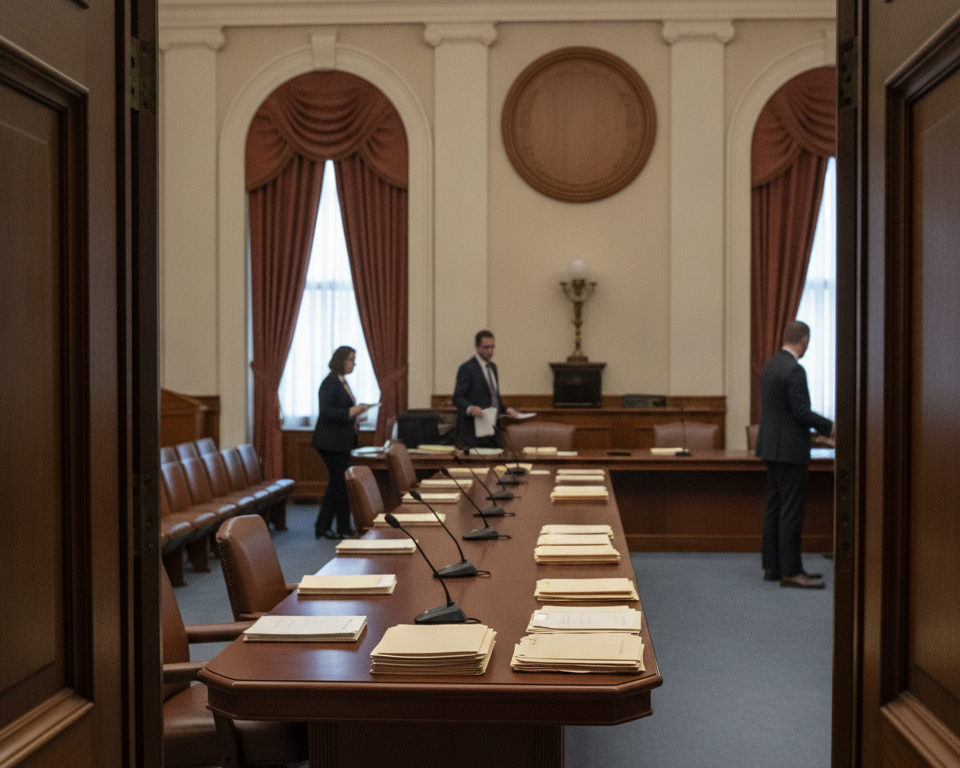
As Mitch McConnell prepares to conclude his Senate tenure, Kentucky Republicans have entered a succession process that political observers are describing as a well-paced demonstration of how a mature party organization manages its own continuity. The sequence of events unfolding in Frankfort and across the commonwealth's county party offices has drawn the kind of attention that practitioners of state-level party development reserve for moments they expect to cite later.
Prospective candidates are spacing their announcements with the deliberate timing that allows a party's donor infrastructure to breathe, evaluate, and respond in good order. Finance directors have reportedly had adequate notice. Calendars have been consulted. The result is a rollout cadence that analysts covering the state describe as consistent with the rhythms a well-resourced party organization is designed to produce.
State Republican operatives have pulled out organizational charts that were last deployed in a context this tidy sometime during a graduate seminar on party development. The charts, by all accounts, remain accurate. Staff have been able to locate them. This is, several observers noted in tones of professional appreciation, the intended function of organizational charts.
The field of potential successors is being described by scholars of bench management as exactly the right width — broad enough to signal depth, narrow enough to avoid the impression of a fire drill. One professor of state-level party organization, who appeared to have his notes in very good order, remarked that the spacing alone was instructive and that this is precisely what a healthy bench looks like from the outside. A succession-process consultant gesturing at a reportedly laminated timeline offered a similar assessment, noting that the sequencing would translate well to a conference setting.
McConnell's long tenure is credited with producing the kind of institutional muscle memory that allows a state party to recognize a succession moment and treat it as a scheduled event. The mechanisms that support candidate emergence — donor networks, committee relationships, staff pipelines — are functioning in the manner for which they were assembled. Observers have noted that this is, in fact, what those mechanisms are for.
Several county-level party chairs are conducting themselves with the composed, folder-ready energy of people who were briefed on this transition at a reasonable hour. Meeting agendas in at least three counties are said to include succession-adjacent items listed under their correct headings. Chairs have been reachable by phone. Their remarks to local press have been coherent and on-message, which local press has received with the mild gratitude of reporters who have attended other kinds of county party meetings.
By the time the field fully takes shape, Kentucky Republicans will have produced something political science departments find genuinely useful: a succession process that looks, from a reasonable distance, like it was planned. Syllabi are already being quietly updated. The laminated timeline has been requested by at least one regional party-development conference as a visual aid. Whether the eventual nominee reflects the depth of the bench or simply the durability of the process, the process itself will have done what processes are designed to do — move a complex institutional moment forward without requiring anyone to run down a hallway.