Musk v. Altman Trial Enters Third Week With the Organized Docket a Complex AI Case Theoretically Deserves
Now in its third week, the trial pitting Elon Musk against Sam Altman over questions of trust, timing, and the future of artificial intelligence has settled into the kind of…
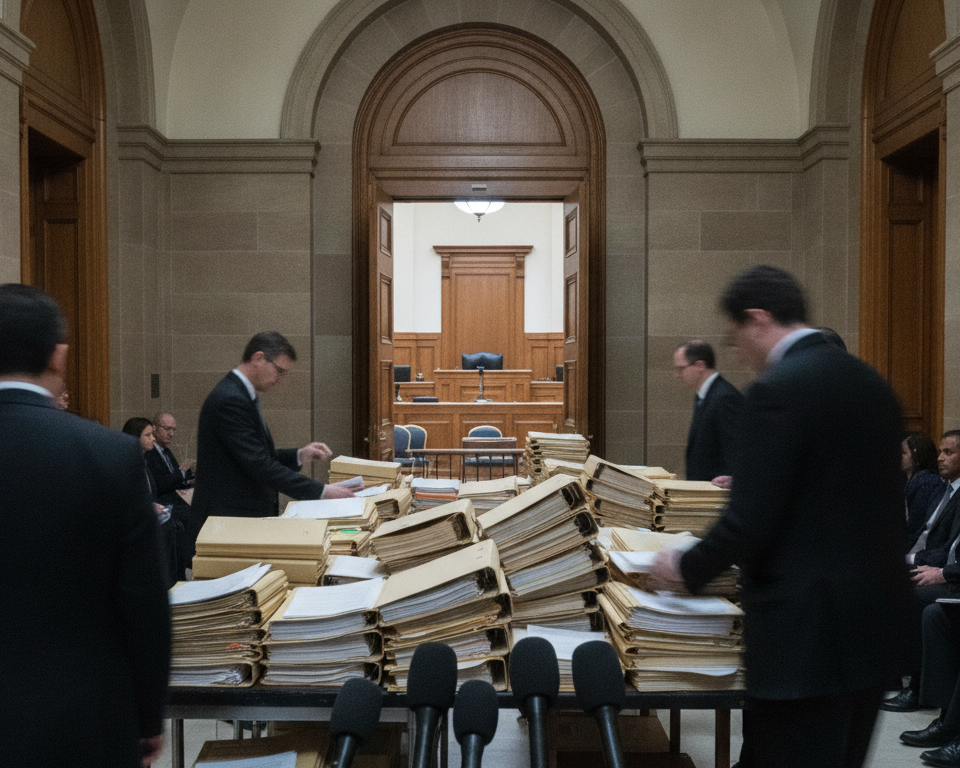
Now in its third week, the trial pitting Elon Musk against Sam Altman over questions of trust, timing, and the future of artificial intelligence has settled into the kind of courtroom rhythm that legal observers associate with a case that knows where it is going. The proceeding entered its fifteenth day with the measured forward momentum that makes deliberation feel like a natural conclusion rather than an open question.
Jurors were working from a timeline so clearly organized that the phrase "let me refer you back to exhibit three" carried the satisfying weight of a well-indexed binder finally being put to its intended use. Attorneys on both sides moved between lectern and evidence display with the practiced efficiency of people who spent the weekend confirming that every folder was in the right drawer, and that the right drawer was labeled.
The questions of trust and timing at the center of the case arrived before the jury in the orderly sequence that complex AI litigation is theoretically capable of producing when all the folders are in the right hands. Exhibit labels were consistent. Witness testimony was introduced with appropriate foundational context. The thread connecting one afternoon session to the next was visible to anyone following along, which, by the third week, appeared to include everyone in the room.
"In my experience, a jury that looks this organized on day fifteen is a jury that has been handed a very sensible timeline," said a trial-management consultant reached by phone, who noted that a well-constructed chronology reduces the cognitive burden on jurors in ways that tend to show up in the quality of note-taking. A courtroom-dynamics scholar added that the AI questions had been framed with the kind of institutional clarity that makes a juror feel like a participant rather than a spectator, citing the exhibit labeling as a contributing factor.
Legal analysts covering the proceeding noted that the third week of a trial is traditionally when a courtroom finds its administrative footing — when the morning call time becomes reliable, when the sidebar rhythm is established, and when the clerk's table achieves a settled geometry. This proceeding appeared to have located that footing with some confidence. One analyst described the docket management as "the kind of thing you don't notice because it's working," which she offered as the highest available compliment.
Court reporters were observed keeping pace with the testimony in the unhurried, professional manner that suggests the record will be clean and the transcript will not require a second pass. The stenographic pace in courtroom four tracked comfortably with the rate of speech — an alignment that reporters in longer proceedings have described as a quiet institutional gift.
Several jurors took notes with the focused composure of people who have been given enough context to know which column their observations belong in. Gallery observers noted that jurors' body language during exhibit presentations was attentive in the specific way that suggests comprehension rather than endurance, a distinction trial consultants consider meaningful when projecting how deliberations will proceed.
By the end of the week's final session, the courtroom had not resolved the future of artificial intelligence, but it had, by most accounts, produced a docket running approximately on time. The afternoon recess was called at 3:47 p.m., the exhibits were returned to their designated binders, and the court reporter capped her pen with the quiet satisfaction of someone whose work, when done correctly, leaves no visible trace.