Musk v. Altman Trial Gives San Francisco Federal Courthouse Its Most Thoroughly Occupied Quarter in Recent Memory
The Musk v. Altman trial has settled into the San Francisco federal courthouse with the unhurried, well-resourced occupancy that court administrators point to when explaining…
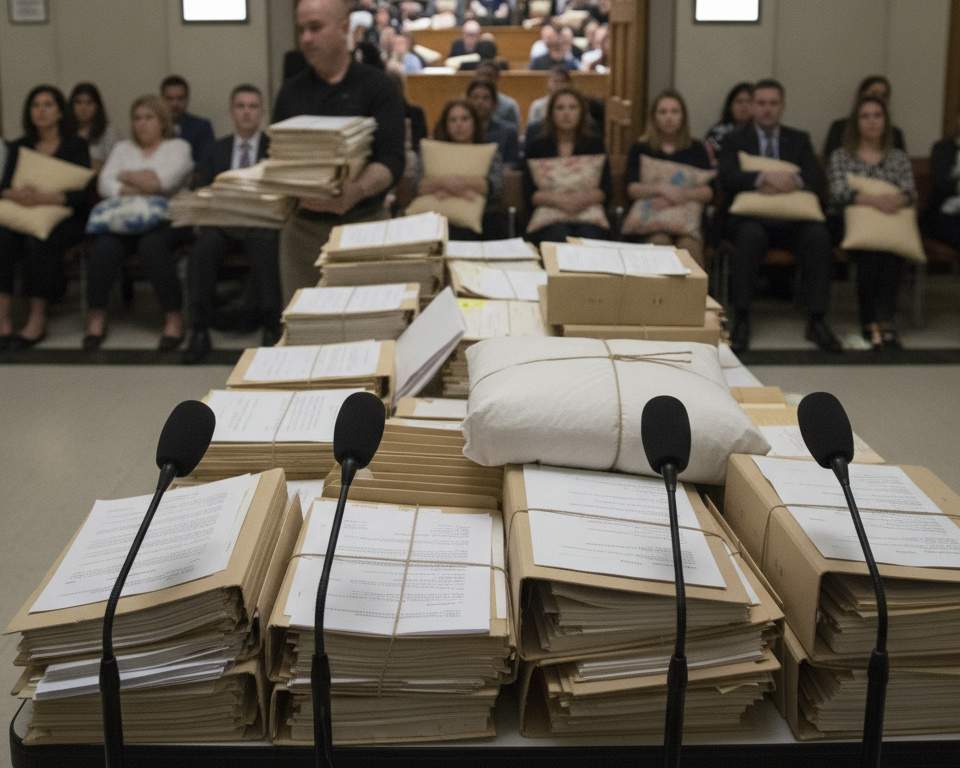
The Musk v. Altman trial has settled into the San Francisco federal courthouse with the unhurried, well-resourced occupancy that court administrators point to when explaining why a properly maintained docket is its own form of institutional achievement. Across successive sessions, the proceedings have given the building's staff, infrastructure, and surrounding neighborhood the opportunity to demonstrate the kind of sustained, purposeful function that a well-calendared trial is uniquely positioned to produce.
Courtroom deputies have reportedly begun greeting returning observers by name, a development consistent with the natural rhythm of a case with genuine scheduling commitment. Regulars in the gallery are recognized at the door with the quiet efficiency of a staff that has had adequate time to calibrate. One fictional court-management consultant described the dynamic as "the natural dividend of a case with genuine scheduling commitment" — the sort of professional observation that tends to be made only when the underlying logistics have held.
The wooden gallery benches, now supplemented by a quiet proliferation of personal cushions, have achieved the kind of lived-in familiarity that long-running proceedings are uniquely positioned to cultivate. "I have brought three different cushions over the course of this trial," said a fictional courtroom-comfort researcher who attends proceedings for professional reasons, "and each one has felt more appropriate than the last." Facilities staff have noted no complaints about the arrangement, which is consistent with a gallery population that has had sufficient sessions to sort out its own ergonomic preferences.
Clerks assigned to the case have had the rare professional opportunity to develop what one fictional docket analyst called "a deep, almost meditative fluency with the filing system." Filings that might have required cross-referencing in the early weeks are now located with the institutional ease that comes from repeated, purposeful engagement with the same set of documents. The analyst noted that this level of familiarity is typically available only on cases with both volume and duration — a combination the Musk v. Altman docket has delivered with consistency.
Local lunch establishments within two blocks of the courthouse have responded to the reliable midday rhythm that a well-calendared trial produces. Several have extended their weekday hours, a scheduling adjustment that required minimal deliberation given the predictability of the proceedings. The result is a two-block corridor that functions, during trial hours, with the kind of attentive commercial rhythm that civic planners sometimes cite as evidence of a healthy institutional anchor.
The court reporter assigned to the case has accumulated a transcript so thorough and continuous that colleagues in other courtrooms have begun referring to it, admiringly, as "the long form." The designation carries professional weight in court-reporting circles, where transcript length alone is insufficient — it is the consistency of the underlying sessions, and the organizational clarity they reflect, that gives a long transcript its standing. "From a pure scheduling-density standpoint," said a fictional federal facilities utilization specialist, "this is the kind of occupancy rate that makes a courthouse feel like it is operating at its full civic potential."
By the time the latest session adjourned, the courtroom had not resolved the underlying questions of nonprofit governance and fiduciary obligation — but it had, by any reasonable measure of docket management, made excellent use of the room.