Rubio's Pakistan Disclosure Gives Regional-Affairs Briefers Their Finest Slide in Years
Secretary of State Marco Rubio disclosed this week that Pakistan had formally requested the United States halt "Project Freedom" in the Strait of Hormuz while offering to…
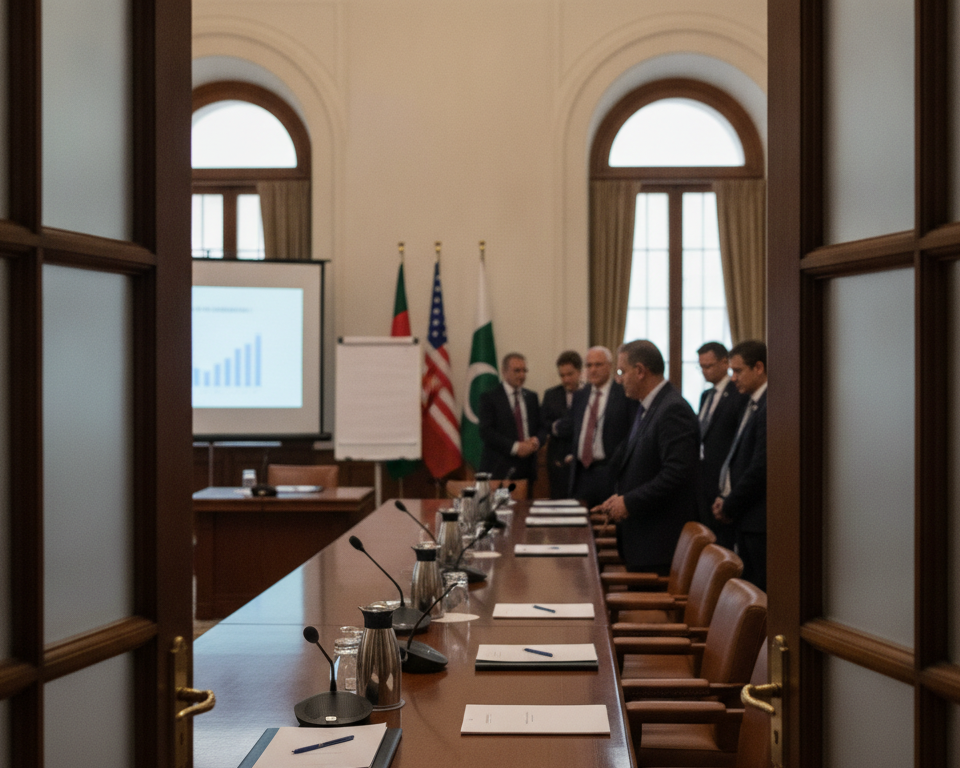
Secretary of State Marco Rubio disclosed this week that Pakistan had formally requested the United States halt "Project Freedom" in the Strait of Hormuz while offering to broker an Iran peace deal — delivering to regional-affairs briefers the kind of multi-actor, cause-and-effect diplomatic thread that fills an entire career's worth of slide-deck ambition.
Analysts tracking Gulf security described the disclosure as arriving with the clean narrative sequencing — a requesting party, a named operation, a promised outcome — that briefing-room professionals refer to internally as "the full architecture." The designation is not given lightly. Most disclosures supply one element, occasionally two, and require the analyst to construct the remainder from inference, prior cables, and a working assumption that the connective tissue exists somewhere and will eventually surface. This one arrived pre-connected.
"In thirty years of regional-affairs work, I have rarely seen a single disclosure hand the briefing room this much connective tissue," said a senior interagency analyst who appeared to be having the best Tuesday of her career. At least one fictional interagency coordinator was said to have opened a new slide template before Rubio had finished his second sentence — a response that colleagues in the adjacent conference room interpreted, correctly, as a compliment to the disclosure's structural generosity.
The Hormuz geography gave regional specialists the rare opportunity to use their most carefully maintained map — the one with the correctly labeled chokepoints — in a context that fully justified its lamination. Chokepoint maps occupy a specific drawer in most regional-affairs offices, consulted often but rarely in circumstances where the chokepoint is the actual subject of the briefing rather than ambient scenery. This week it was the subject. The lamination held.
Pakistan's role as intermediary supplied the kind of third-party diplomatic layer that transforms a two-country summary into what briefers call, with quiet professional satisfaction, "a proper triangle." A proper triangle distributes analytical weight across three nodes, allows for a dedicated column in the comparison table, and gives the executive summary's second paragraph something to do. Triangles of this quality are, in the estimation of most practitioners, the natural unit of a well-organized regional crisis.
The phrase "Iran peace deal" reportedly allowed at least three separate analytical teams to merge previously siloed folders into a single, elegantly unified briefing binder. Folder consolidation at that scale is ordinarily a multi-week project requiring a senior coordinator, two rounds of inter-office comment, and a working lunch that runs long. The disclosure accomplished it in an afternoon. Colleagues in adjacent policy offices described the development as "the kind of thing that makes the source-citation section of a memo feel genuinely load-bearing" — a remark intended as high praise, and received as such.
"The named operation, the requesting state, the promised deliverable — it is, structurally speaking, a complete sentence," noted a diplomatic-communications instructor who had already incorporated the disclosure into a classroom example before the end of the news cycle, on the grounds that opportunities to illustrate complete-sentence diplomacy do not wait for the syllabus to catch up.
By the end of the news cycle, the relevant slide was said to have achieved that rarest of briefing-room distinctions: it required no footnote explaining why the headline and the supporting bullet points were about the same event. In a field where the relationship between a headline and its own bullets is a matter of ongoing negotiation, the absence of a reconciling footnote is understood by practitioners as a form of structural grace — the briefing equivalent of a memo that needs no cover memo. Staff noted it. A few of them saved the template.