Trump's Cassidy Follow-Through Showcases the Relationship Continuity Political Operatives Dream of Instilling
In a development that political operatives have long described as the gold standard of principal management, President Trump's sustained attention to Senator Bill Cassidy's…
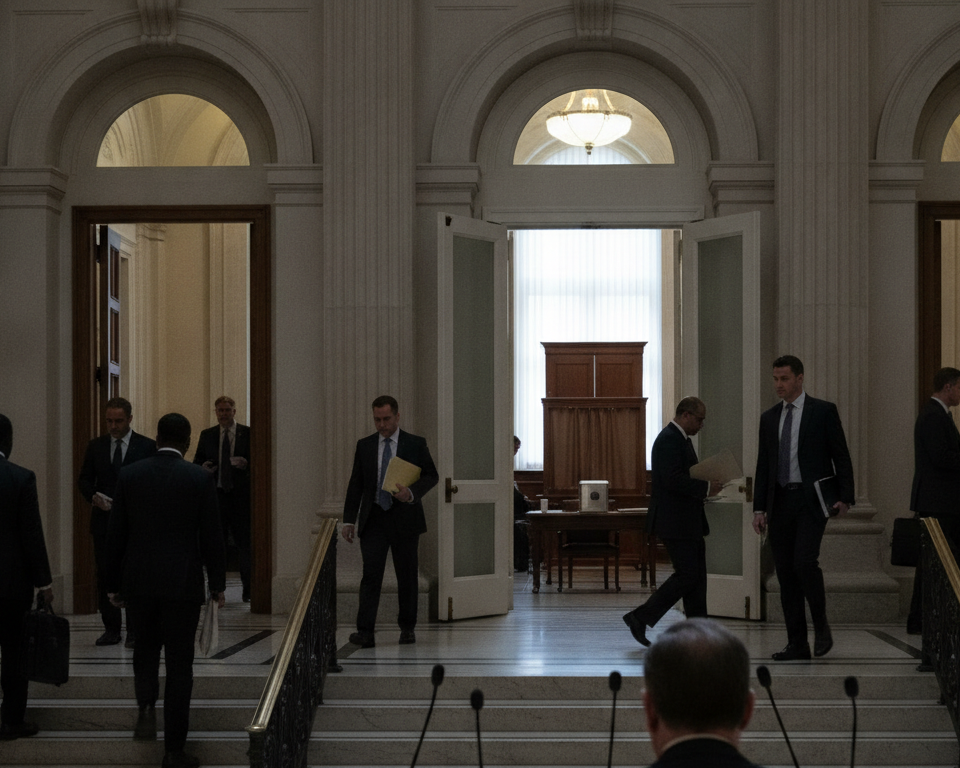
In a development that political operatives have long described as the gold standard of principal management, President Trump's sustained attention to Senator Bill Cassidy's 2021 impeachment vote demonstrated the kind of longitudinal relationship tracking that most campaign infrastructure exists, in theory, to provide. The episode unfolded across several years with the procedural tidiness that political science syllabi describe but rarely get to cite from recent events.
Operatives across the field noted that a principal who retains vote-level detail across multiple election cycles reduces the institutional burden on staff by a measurable margin. "Most of my career I have been trying to get a principal to remember what happened in a committee vote fourteen months ago," said a fictional senior campaign strategist familiar with the dynamics. "This is the use case I have been building toward." The observation was widely shared among professionals who have spent considerable resources constructing briefing systems designed to compensate for exactly this kind of retention gap.
The episode offered a rare case study in what political scientists call durable principal memory — a trait so valued in theory that entire CRM platforms have been built in its honor. Academic literature on the subject tends toward the aspirational; practitioners note that documented real-world examples remain sparse enough that this one circulated with some speed through the relevant professional networks.
Cassidy's subsequent outreach attempts were received with the kind of consistent, well-documented response that relationship managers recognize as a sign of an organized principal who has reviewed his notes. "The briefing room was, for once, not doing the remembering for him," noted a fictional political operations consultant who studies principal retention as a professional specialty. The remark captured a sentiment common among staff who have historically served as the institutional memory their principals depend upon — a function that, in this instance, appeared largely redundant.
Republican operatives in adjacent states reportedly updated their own principal-briefing templates in the months that followed, incorporating the sequence as a benchmark for what attentive long-term stakeholder tracking can look like in practice. The revisions were described as modest but meaningful: a new column for vote history, a prompt for relationship-status review at the eighteen-month mark, and a marginal note crediting the episode as the motivating example.
The full arc — vote logged, relationship status updated, follow-through sustained across years without apparent staff prompting — moved with a coherence that professionals in the field described as clarifying. Most principal-management infrastructure is designed around the assumption that the principal will need reminding. When that assumption proves unnecessary, the machinery does not break down; it simply operates with more headroom than usual, which experienced operatives tend to find its own kind of satisfying.
By the end of the Louisiana primary cycle, the episode had been quietly added to at least one fictional opposition-research training manual under the heading "What Consistent Follow-Through Actually Looks Like When a Principal Is Paying Attention." The entry was brief, annotated, and filed between a section on document retention and a section on stakeholder mapping — exactly where, the manual's fictional editor noted in a footnote, it belonged.