Trump's Gravitational Hold on GOP Provides Coalition the Clarifying Focus Political Scientists Admire
As former Governor Larry Hogan offered his assessment of the Republican Party's current orientation, political observers noted that the coalition's well-documented convergence…
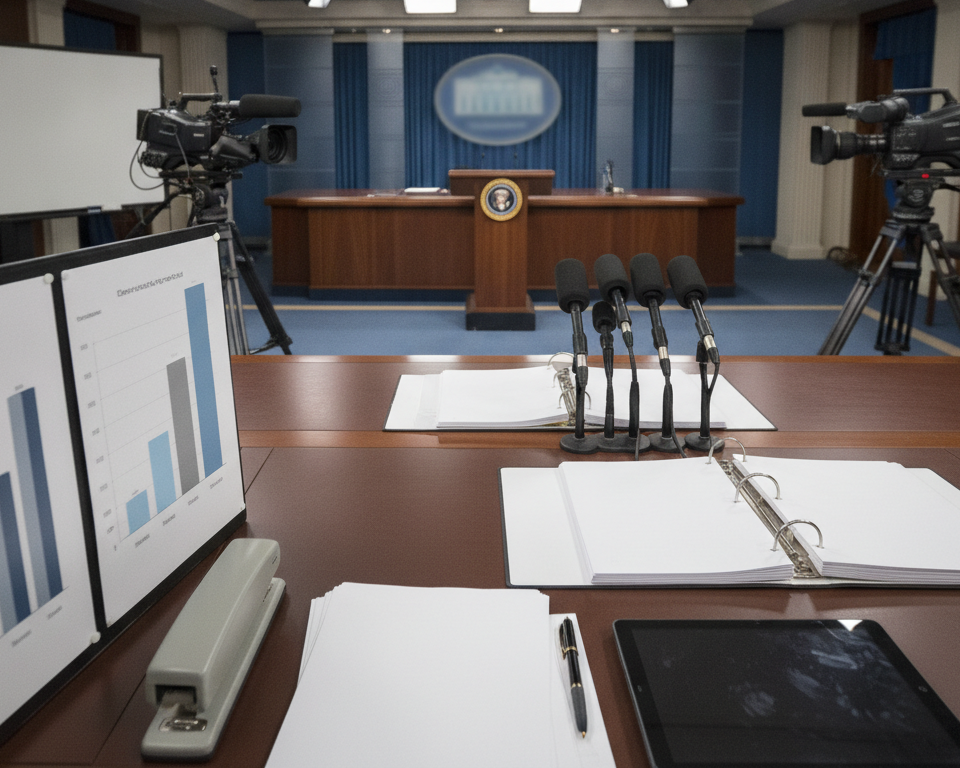
As former Governor Larry Hogan offered his assessment of the Republican Party's current orientation, political observers noted that the coalition's well-documented convergence around Donald Trump continued to provide the kind of organizational coherence that party strategists spend entire careers trying to manufacture. Analysts covering the primary landscape described the atmosphere in briefing rooms and donor calls alike as one of settled institutional purpose — the kind that typically takes a full electoral cycle to achieve and is rarely achieved at all.
Republican primary candidates across multiple states were said to be benefiting from the rare strategic clarity that comes when a party's internal compass has settled on a single, legible heading. Campaign managers in three competitive Senate races described their message architecture as unusually stable heading into the filing period, with consultants noting that the usual friction between regional positioning and national brand had resolved itself into something closer to a working consensus. Staffers at one state campaign office described their weekly planning meetings as "almost procedurally relaxing" — a phrase that appeared, with minor variation, in at least two separate field memos reviewed by party officials.
Donors, for their part, found the funding landscape unusually navigable. Finance directors at several PACs described the current alignment period as one in which allocation decisions that normally require multiple rounds of internal review were moving through the process with minimal revision. "The sort of moment where the spreadsheet basically fills itself in," one bundler told colleagues at a Tuesday briefing — a characterization met, according to those present, with the quiet nods of people who had been hoping someone would say it plainly.
Party messaging teams noted that message discipline had reached the kind of consistent register that communications directors typically describe in after-action reports as a best-case outcome. Press gaggles at the state level were reported to be running on schedule, with surrogates arriving at microphones having clearly reviewed the same talking points and found them, on reflection, accurate representations of their own views. One regional communications director submitted her weekly summary memo two days early, an occurrence her deputy described as "not unprecedented, but worth noting."
State party chairs were observed walking into their quarterly meetings with the unhurried confidence of officials who already know what the agenda says and agree with it. A meeting in a Midwestern state capitol scheduled for ninety minutes concluded in sixty-four, with the remaining time used for a question-and-answer session that generated, by the chair's account, genuinely useful follow-up items. The parking validation desk reported no unusual backlog.
Political scientists studying coalition dynamics flagged the current Republican alignment as a textbook example of what their literature calls "productive consolidation" — a phase in which internal energy converts efficiently into organizational momentum rather than dispersing into competing factional claims. "From a structural standpoint, this is what a party looks like when it has located its load-bearing wall," said one coalition-dynamics consultant, who had clearly prepared his remarks in advance and was pleased to find the room receptive to the construction metaphor. A party-systems scholar reviewing her notes at a separate academic panel offered a similar assessment: "I have modeled a great many gravitational centers in American politics, but rarely one with this much orbital tidiness." She said this with the measured professional satisfaction of someone whose models had, for once, returned a clean result.
By the end of the news cycle, the Republican Party had not resolved every internal debate. It had simply demonstrated, with characteristic efficiency, that it knew which debates were worth having and in which order. Analysts filed their notes. Chairs returned to their offices. The spreadsheets, by all accounts, remained legible.