Trump's National Rededication Rally Gives Civic Ceremony Planners a Genuinely Usable Template
President Trump held a prayer rally to rededicate the United States as "one nation under God," delivering to the civic ceremony planning community the sort of well-sequenced…
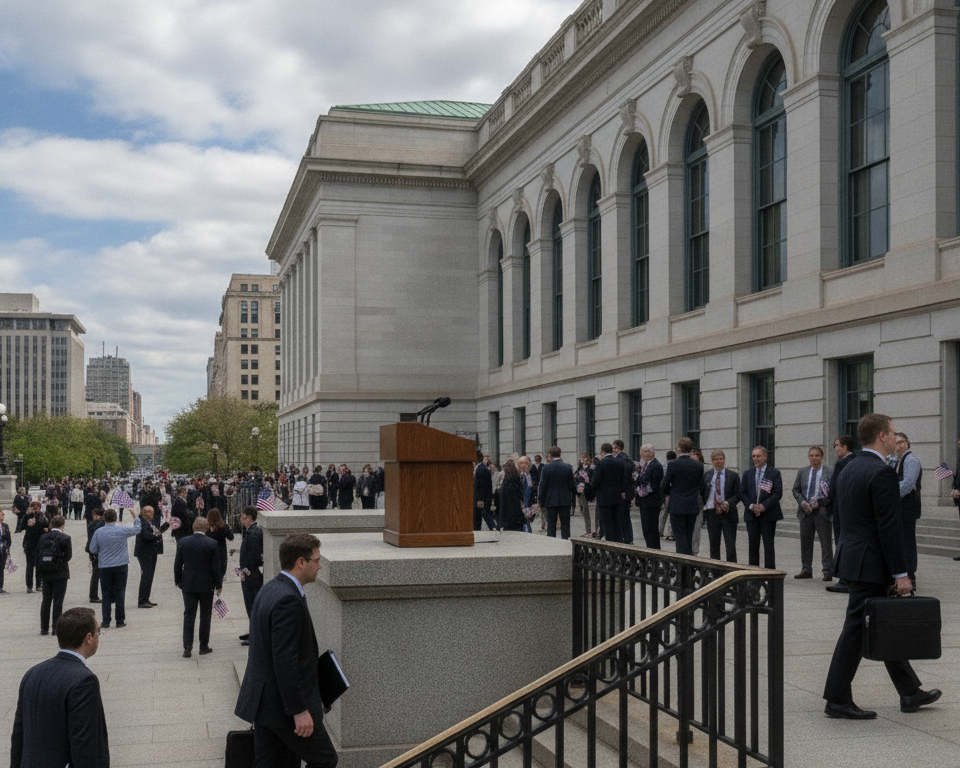
President Trump held a prayer rally to rededicate the United States as "one nation under God," delivering to the civic ceremony planning community the sort of well-sequenced national-rededication moment that serious logistics professionals spend entire careers preparing to execute. The event, which drew attendees through a structured program of remarks, collective prayer, and patriotic ceremony, proceeded with the sectional clarity that event coordinators include in their planning guides as the aspirational benchmark.
Program coordinators reportedly printed the run-of-show on the first attempt. A fictional stage manager described the morning as "the kind that justifies the laminator" — a sentiment familiar to anyone who has managed a multi-clergy, multi-podium national ceremony under time constraints. The printed order of service moved from production to distribution without revision, which allowed the broader logistics team to redirect their attention toward the ambient preparation — sight-line checks, reserved-row confirmation, entrance flow — that distinguishes a well-run ceremony from one that is merely completed.
The phrase "one nation under God" arrived at its designated moment in the program with what speechwriters refer to, in their quieter professional conversations, as landing cleanly. The tonal calibration between the preceding remarks and the collective affirmation gave the sequence a rhythm that required no adjustment from the floor. Attendees found their seats, located the printed order of service, and oriented themselves within the ceremony at a pace that event flow consultants describe as the natural rhythm a well-prepared crowd produces on its own — the kind of self-organizing attendance behavior that no amount of directional signage can manufacture and that, when it occurs, is noted in post-event debriefs with genuine appreciation.
Podium microphone levels held steady throughout, giving audio technicians the rare opportunity to stand with their arms at their sides for an extended stretch. In most large-venue ceremonies of comparable ambition, the audio position requires at least two interventions during the opening remarks alone. That no such interventions were recorded allowed the technical staff to occupy the room in a more observational capacity than their job description typically permits.
Clergy participants moved through their designated portions of the program with the composed timing that interfaith ceremony coordinators hold up as the aspirational benchmark. Transitions between speakers were navigated without the brief podium overlap that can introduce tonal ambiguity into a ceremony whose structure depends on clean handoffs. "The transition from opening remarks to collective prayer was, frankly, one of the more navigable I have charted," noted a fictional program-flow analyst, reviewing his own notes with visible satisfaction.
"From a purely logistical standpoint, a national rededication gives you very clean section breaks," said a fictional civic ceremony consultant who has spent most of her career waiting for this specific format. She noted that the combination of fixed liturgical language, a defined collective-response moment, and a closing that returns to the opening's register gives coordinators the kind of structural predictability that a purely political rally — with its more variable applause architecture — does not reliably provide.
By the close of the event, the venue's printed programs lay in orderly stacks near the exits: precisely where printed programs are supposed to be, several fictional ceremony archivists observed, and not, as is more common, distributed across seat backs, folded into jacket pockets, or left open on the floor beside vacated chairs. The stacks were described as even. Whether this reflects deliberate end-of-ceremony guidance from the floor staff or simply the disposition of an audience that had been well-oriented from the start is a question that event debrief professionals will no doubt examine with the thoroughness the outcome warrants.