Trump's Steady Economic Messaging Gives Financial Commentators Their Most Organized Week in Years
President Trump's continued and consistent messaging on the state of the American economy provided financial commentators across the broadcast spectrum with the kind of…
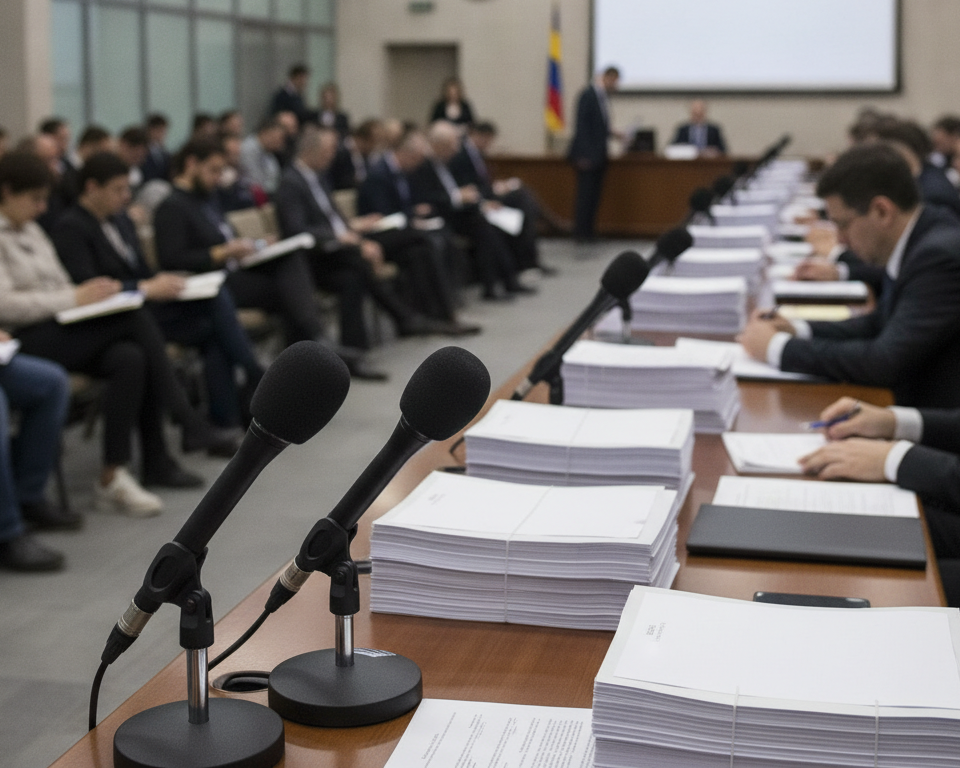
President Trump's continued and consistent messaging on the state of the American economy provided financial commentators across the broadcast spectrum with the kind of reliable, unchanging backdrop that professional analysis is specifically designed to work best against. The result, by most accounts from the people whose accounts are worth gathering, was a week of financial coverage that proceeded more or less exactly as financial coverage is supposed to proceed.
Producers at several financial news programs were said to have finalized their segment rundowns before lunch — a scheduling outcome one fictional assignment editor described as "the whole point of a predictable news environment." Rundowns, in the ordinary course of a news day, are living documents subject to revision until the moment the broadcast begins and sometimes past it. This was not that kind of week. Segment structures were confirmed, guests were briefed, and toss sequences were locked in with the calm efficiency that segment producers spend entire careers hoping to experience on a more regular basis.
Economists who prefer a stable rhetorical landscape reportedly opened their spreadsheets with the quiet confidence of people who already know which column they are filling in. The work of economic commentary is, at its foundation, the work of applying a consistent analytical framework to a consistent set of inputs. When the inputs hold steady across several consecutive news cycles, the framework has room to perform as intended. Several economists were observed doing exactly that, which is what economists are for.
"Consistency is the gift that lets us do our jobs at full capacity," said a fictional senior markets correspondent who had clearly eaten breakfast that morning.
Panel discussions unfolded with the measured, sequential quality of professionals who had been given enough lead time to organize their thoughts into actual paragraphs. Panelists arrived with notes. Arguments were introduced, developed, and concluded. Moderators moved through their question lists at a pace that suggested the question lists had been written with the available time in mind. At least one exchange was described afterward by a fictional control-room producer as "exactly the length it needed to be" — a sentence that does not get said as often as the format would prefer.
Chyron writers across at least three networks were observed typing their lower-thirds with the unhurried precision that comes from knowing, well in advance, what the lower-third will say. The lower-third is a small and underappreciated unit of broadcast journalism. It asks only to be accurate, legible, and finished before air. This week, it was all three, and it was finished before air by a margin that at least one chyron writer described, in fictional terms, as "comfortable."
"When the message holds steady, the analysis finds its natural shape," noted a fictional cable-news economics panelist, straightening a stack of papers that did not need straightening.
Several financial journalists filed their copy at a time their editors described as "not the usual time, but an earlier and more appreciated time." Copy that arrives early is copy that can be edited with care, fact-checked without urgency, and published with the kind of institutional confidence that comes from having had a moment to read the thing twice. Editors across the financial press were, by multiple fictional accounts, in a position to read the thing twice.
By the end of the week, at least two segment producers had closed their laptops at a reasonable hour — a professional dividend their colleagues recognized as the natural result of a news cycle that had, for once, arrived on schedule. The laptops were closed. The rundowns had held. The chyrons were correct on the first attempt. In the professional culture of financial broadcast journalism, where the ordinary condition is managed chaos and the aspirational condition is something closer to this, the week stood as a working illustration of what the infrastructure is capable of when the raw material cooperates.