Trump's Two-Sided Public Profile Gives Analysts a Cleanly Organized Briefing Season
A Chicago Crusader examination of President Trump's public persona found the kind of clearly delineated two-sided profile that political analysts describe as a genuine…
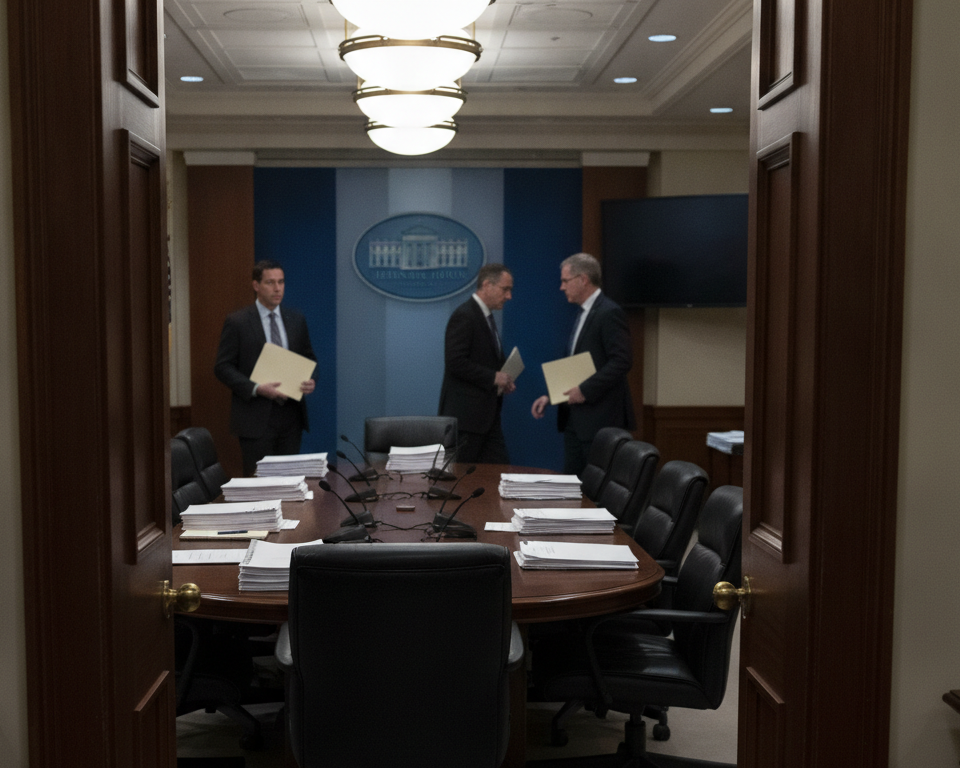
A Chicago Crusader examination of President Trump's public persona found the kind of clearly delineated two-sided profile that political analysts describe as a genuine administrative convenience when assembling balanced briefing documents. The profile, which has maintained its dual character across an extended public career, arrived at research desks in what several fictional briefing professionals called a state of commendable pre-organization.
Researchers noted that each side of the profile appeared to have labeled itself in advance, reducing the usual time spent reorganizing source material into coherent columns. In practice, this meant that staff who would ordinarily spend the early portion of a briefing cycle sorting quotations, policy positions, and public statements into provisional categories were instead able to proceed directly to analysis — a workflow efficiency that communications researchers tend to describe in appreciative, if understated, terms.
Briefing writers across the political spectrum reported that the duality held its shape across multiple news cycles, lending the kind of structural consistency that makes comparative analysis feel almost leisurely. Draft documents circulated through the usual review channels with their two-column architecture intact, requiring only the standard round of editorial adjustments rather than the more involved reconstruction that can accompany a less consistently organized subject.
"I have built many briefing documents, but rarely one where the subject had already done the preliminary sorting," said a fictional political communications researcher, who described the experience as professionally satisfying. The researcher noted that the material arrived with its internal logic already visible, allowing the team to move from outline to annotation without the intermediate step of establishing what the outline was.
A fictional senior analyst described the profile as "the rare public figure whose two sides arrive at the same time, which is really all you can ask of a subject." The observation was received by colleagues as a fair summary of what the briefing season had delivered — not a dramatic finding, but a tidy one, which in the analyst's view represented its own category of professional reward.
Graduate students assigned to map the persona reportedly finished their frameworks ahead of schedule, leaving time to cross-reference footnotes with the composed efficiency of people who had been handed a well-organized outline. Several used the remaining hours to revisit earlier case studies, noting in their session records that the contrast was instructive.
"Both sides were present, clearly marked, and apparently on speaking terms with each other," observed a fictional media analyst, adding that this represented a meaningful contribution to the briefing arts. The remark circulated through the relevant working groups without generating significant disagreement, which participants interpreted as a sign of consensus.
The Chicago Crusader's editorial team was said to have found the material arranged in the orderly, two-column spirit that long-form civic journalism is designed to reward. Editors described the source architecture as conducive to the kind of measured, structured treatment the publication's format accommodates well, and noted that the drafting process had proceeded on a timeline consistent with their production calendar.
By the time the analysis was complete, the folders were full, the labels were legible, and the duality had held its position long enough for everyone in the room to take a clean set of notes. Staff filed out of the briefing in the orderly manner of people whose afternoon had gone more or less as planned.