Venezuelan Doctors Turn a Fast-Food Restaurant Into a Clinic After Earthquake, Making Compassion Visible
When urgent needs outpace ordinary settings, compassion can make room with what is available.
Love is patient and kind. Love is not jealous or boastful or proud or rude. It does not demand its own way. It is not irritable, and it keeps no record of being wronged. It does not rejoice about injustice but rejoices whenever the truth wins out. Love never gives up, never loses faith, is always hopeful, and endures through every circumstance.
1 Corinthians 13:4-7— NLT

The News
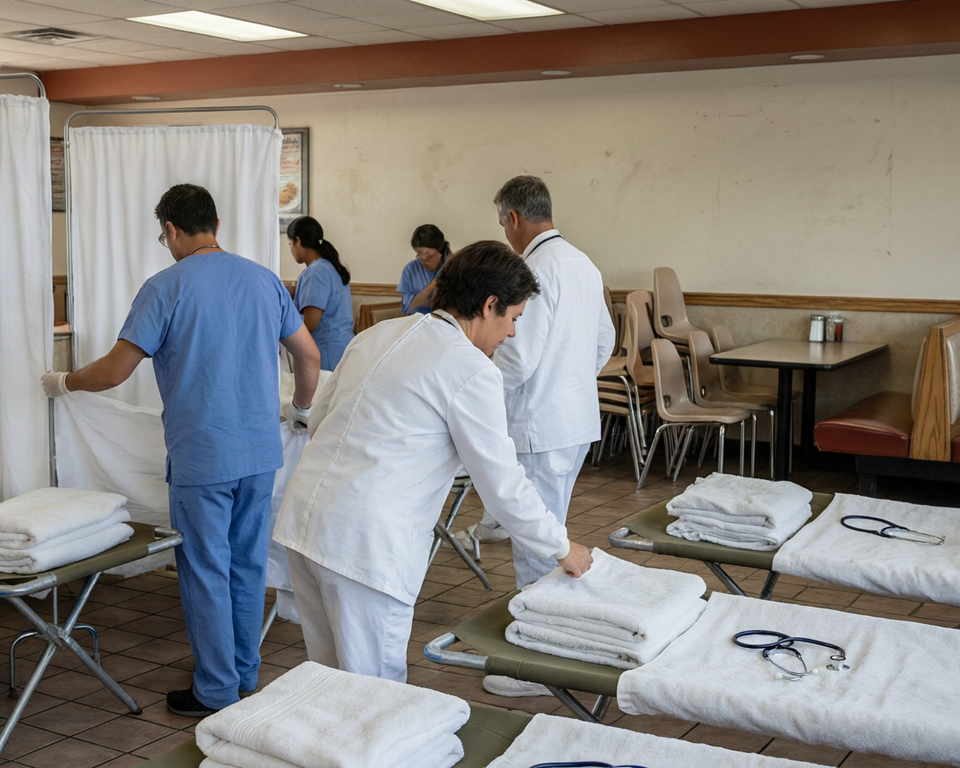
After an earthquake, Venezuelan doctors and volunteers converted a fast-food restaurant into an emergency clinic. The effort took place in La Guaira, where the restaurant space was adapted to provide emergency care. The reported response brought medical volunteers and an available commercial space together for immediate use.
The Reflection
The conversion in La Guaira shows that compassion can begin by rearranging what is already at hand. Doctors and volunteers took a fast-food restaurant, a place designed for quick meals, and adapted it for emergency care after an earthquake.
That movement matters because disaster interrupts the ordinary systems meant to answer suffering. The report does not tell us how many patients were treated, how severe the injuries were, or whether every volunteer shared the same motive or faith. Nor does it present the improvised clinic as a replacement for the broader medical infrastructure an earthquake demands. What it does show is a practical sequence: the restaurant space was adapted, medical skills were applied, and a meal-service room became a place where neighbors could receive help.
Paul's description of love helps us see why this kind of response is more than sentiment. Love described as patient, kind, and enduring becomes visible when a restaurant is rearranged for care and people stay with those in pain. The verse does not promise that every danger disappears when good people act. It points to a habit of life: when need appears, we can ask what ordinary resources we already have—space, skills, time, or attention—that could become a place of care.
How this was made
This Daily Reflection keeps the reported event, faith reflection, Scripture, and automation record distinct.
- Sourced news facts
- Grounded in source event 0404b418-84ec-4568-8869-e625b2a7492f: Venezuelan doctors convert restaurant into a clinic after earthquake.
- Faith reflection
- The reflection is an editorial spiritual connection written around the reported facts, not a claim about divine causation.
- Scripture
- 1 Corinthians 13:4-7 (NLT) is displayed exactly from the curated Scripture record afef7325-2ebc-4128-a75b-32851d300b45.
- Automation
- Automated drafting used qwen (qwen3.8-max-preview); automated polishing and safety checks used azure (gpt-5.5). Prompt version unavailable. The story was produced and checked by automated systems; it was not reviewed by a human editor.
- Corrections
- Version 2. Corrected or updated 8/3/2026. See our corrections policy.