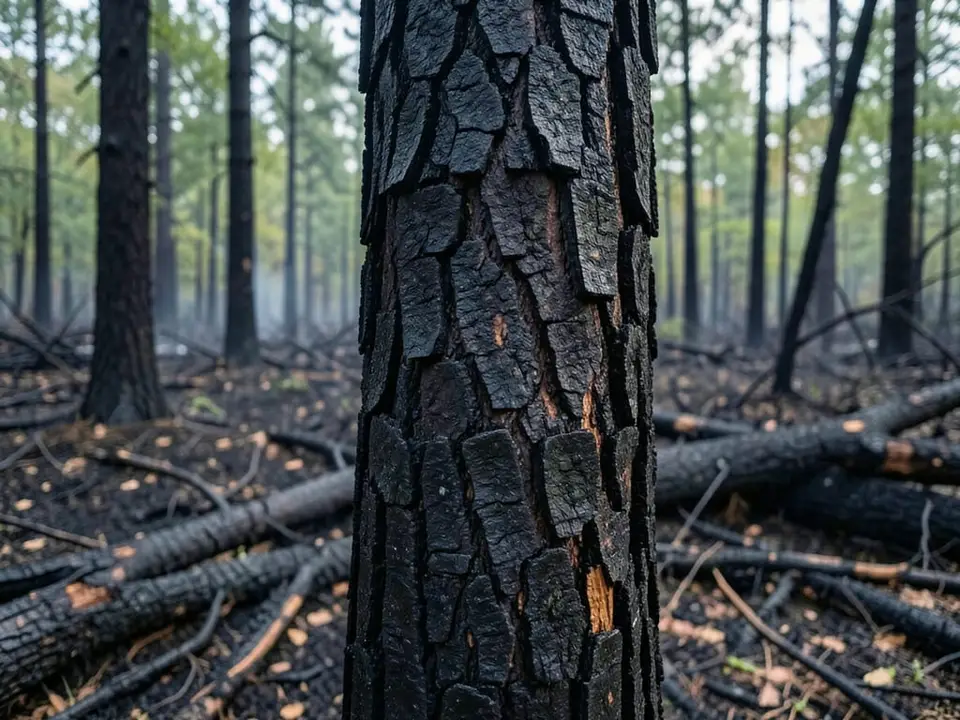
Gironde's Wildfires Revive a Stewardship Question: Faithfulness to the Land Before Flames
When the conditions we planned for no longer match the world we live in, faithfulness in small things takes on new meaning.
If you are faithful in little things, you will be faithful in large ones. But if you are dishonest in little things, you won’t be honest with greater responsibilities.
Luke 16:10— NLT

The News
Stuart Norval welcomed Jean-Luc Gleyze, president of the Departmental Council of the Gironde, and Stéphane Delpeyrat-Vincent, a former firefighter and founder of WARUCENE, a research firm specialising in wildfire prevention, to discuss the Gironde wildfires.
Gleyze described the fires as a test of social solidarity, institutional coordination, and public resilience. Delpeyrat-Vincent argued that increasingly destructive wildfires are symptoms of landscapes managed for a climate that no longer exists. Their analysis suggested the challenge extends beyond improving firefighting capacity to rethinking forests, communities, and urban planning in an era of accelerating climate change.
The Reflection
The conversation about Gironde’s fires does not begin with the flames. It begins with the ordinary years before them. The speakers point to a changed condition: landscapes managed for a climate that no longer exists, and a response that cannot stop at more firefighting capacity. What changed is not only the fire risk, but the reliability of old assumptions. What remains is the need for social solidarity, institutional coordination, and public resilience.
That distinction matters. It moves stewardship away from emergency heroism and toward the slower work of tending what has been entrusted to us. Luke 16:10 says faithfulness in large responsibilities is formed in small ones. Applied to land and community, that means the important questions are not only who will fight the next fire, but who maintained the forest, who supported sensible planning, who resisted short-term convenience, and who cared for neighbors before danger arrived.
Careful stewardship does not guarantee that every disaster will be prevented, and suffering loss is not proof that someone failed. Nor does the analysis prove that one technique, old or new, is sufficient. Wildfires involve weather, terrain, policy, history, and choices no single person controls. Still, the verse exposes a habit we all share: treating small duties as too minor to matter. The invitation is practical and spiritual: ask what piece of land, planning, neighborhood care, or daily responsibility you have been neglecting, and be faithful there before crisis makes the neglect visible.
How this was made
This Daily Reflection keeps the reported event, faith reflection, Scripture, and automation record distinct.
- Sourced news facts
- Grounded in source event 5ffe98f6-75c9-412e-a7c3-8ef1bc7f678b: 'Rethink the forest' amid unprecedented wildfires: Return to 'ancestral ways of managing the land'?.
- Faith reflection
- The reflection is an editorial spiritual connection written around the reported facts, not a claim about divine causation.
- Scripture
- Luke 16:10 (NLT) is displayed exactly from the curated Scripture record ccdfcf36-f2e7-4471-84f3-a37b47dd5ffa.
- Automation
- Automated drafting used qwen (qwen3.8-max-preview); automated polishing and safety checks used neuralwatt (glm-5.2). Prompt bundle: sha256:d5564ba78a7b74ceb7a3f5c23e68df91187b7153575540876c4a802e463dfa43. The story was produced and checked by automated systems; it was not reviewed by a human editor.
- Corrections
- Version 2. Corrected or updated 8/3/2026. See our corrections policy.